Gas vs Electric Patio Heaters: What’s Best for Outdoor Spaces in College Station & Bryan?
College Station winters are nothing like Minnesota winters, but they’re real enough to shut down your patio from November through February if you’re not prepared. Temperatures regularly drop into the low 30s overnight, cold fronts roll through with little warning, and the combination of damp air and wind chill makes an unheated outdoor space feel significantly colder than the thermometer reads.
The good news is that the right outdoor heater makes a covered patio, restaurant terrace, or backyard event fully usable even in January. The not-so-good news is that the wrong heater for your specific space will underperform, waste energy, or create a safety issue. This guide gives you a straight comparison of gas vs electric patio heaters for the Bryan–College Station climate, with sizing guidance and clearance requirements to help you make the right call.
How Each Heater Type Works — and Why It Matters for Texas Weather
Gas Patio Heaters (Propane)
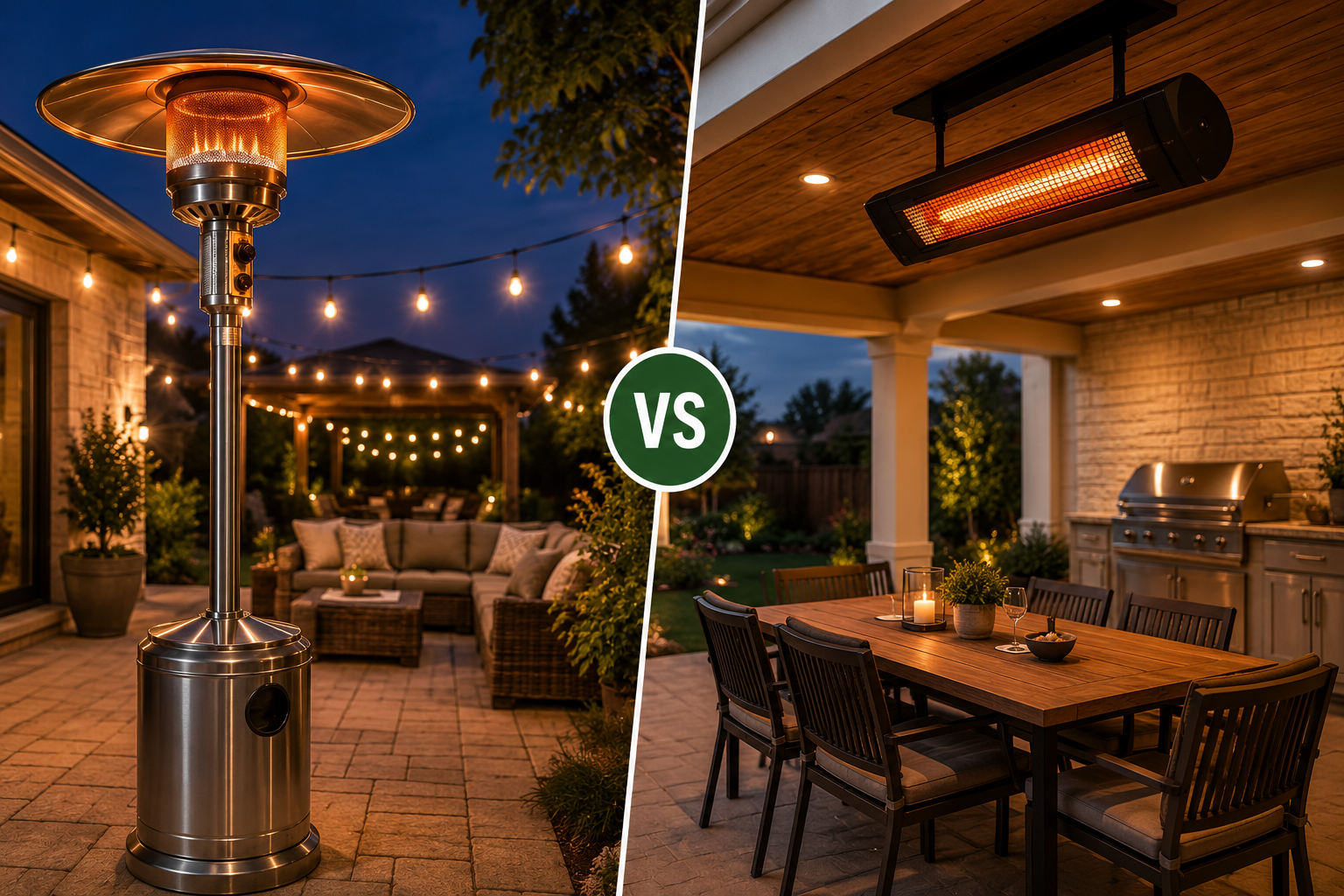
Gas patio heaters burn propane or natural gas to produce a flame that heats a metal radiator, which then radiates warmth outward in all directions. The tall mushroom-top tower design is the most common style, pushing heat downward and outward into a roughly 20–25 foot diameter zone. Output is measured in BTUs — most residential gas heaters run between 30,000 and 48,000 BTU, while commercial units go higher.
The key advantage of gas for the Brazos Valley is raw heat output. On a genuinely cold January evening with a north wind running across an open backyard, a 48,000 BTU propane heater will keep people comfortable where an electric unit simply cannot produce enough heat to compete with the wind. Our gas patio heater rental College Station includes propane tanks, delivery, and setup so there’s nothing to manage on your end.
Electric Patio Heaters (Infrared)
Electric patio heaters use infrared heating elements to produce radiant heat — the same type of heat you feel from the sun. Instead of warming the air (which is inefficient outdoors), infrared heaters warm people and objects directly. The best electric units are rated at 1,500 to 4,000 watts, produce instant heat with no warm-up time, and can be wall-mounted, ceiling-mounted, or freestanding.
For a covered patio in College Station — a pergola, a screened porch, or a restaurant terrace — electric infrared heaters are often the stronger long-term choice. They’re cleaner, quieter, and safer in an enclosed space where combustion gas cannot be used. Our electric patio heater rental College Station covers both portable and fixed-mount options for any space configuration.
Gas vs Electric Patio Heaters: Side-by-Side Comparison
Here’s how both heater types stack up across every factor that matters for outdoor spaces in the Bryan–College Station area:
| Feature | Gas Patio Heater | Electric Patio Heater |
|---|---|---|
| Heat output | 30,000–50,000+ BTU—very high | 1,500–4,000W / 5,000–14,000 BTU |
| Area covered | Up to 25 ft diameter per unit | Up to 9–12 ft radius per unit |
| Open/closed space | Best for open, outdoor, windy areas | Best for covered, semi-enclosed patios |
| Portability | High — propane tank, no wiring needed | Medium — needs outlet, cord management |
| Running cost | Propane ~$1–2/hr; lower upfront | Electricity ~$0.15–0.40/hr; higher upfront |
| Warm-up time | Instant heat, no warm-up | 1–3 min warm-up (infrared: instant) |
| Wind performance | Good — high BTU pushes through light wind | Moderate — open element loses heat in wind |
| Safety indoors | NO — combustion gas, outdoor only | YES — safe for covered/enclosed patios |
| Aesthetics | Tall mushroom-top tower; visible flame | Sleek, wall-mount, or ceiling-mount options |
| Best for College Station winters | December–February nights; open yards & events | Oct–Feb; covered patios, restaurants, home outdoor dining |
How to Size a Patio Heater for Your Outdoor Space
Sizing is where most people go wrong. Buying or renting too little means guests are still cold. Buying too much wastes money and can create a space that feels uncomfortably hot directly under the heater while the edges remain cold. Here’s the straightforward approach for common outdoor spaces in College Station:
The basic rule of thumb for gas heaters: allow approximately 1,000 BTU per 10 square feet of outdoor space you want to heat. For a 300 sq ft open patio, that’s one 30,000 BTU unit. For open areas or windy conditions, add 25% to that calculation. For electric heaters, plan for one 1,500–2,000 watt unit per 100–150 square feet of covered space.
| Space Type | Size | Recommended | Units Needed |
|---|---|---|---|
| Small covered patio | Up to 150 sq ft | Electric infrared | 1 unit |
| Medium covered patio | 150–300 sq ft | Electric (2 units) or 1 gas | 1–2 units |
| Open backyard / deck | 300–500 sq ft | Gas propane tower | 1–2 units |
| Large open yard / event | 500–1,000 sq ft | Multiple gas heaters | 3–5 units |
| Restaurant patio | Varies | Electric wall/ceiling mount | Per zone |
| Event rental space | Varies | Gas towers for open areas | Per 200 sq ft |
■ Sizing Tip: Think in Zones for Larger Spaces
Rather than trying to heat your entire yard or patio with one large unit, divide the space into 15–20 foot zones and place one heater per zone. This gives more even coverage and avoids the hot-center-cold-edge problem that single large heaters create. For events and restaurant patios, zoning also lets you turn off sections of heating as the evening progresses and guests concentrate in specific areas.
Requirements: What You Must Know Before You Set Up
Clearance requirements exist for both safety and performance reasons. Setting up a heater too close to overhead structures, walls, or flammable materials is a fire risk. Setting it up with too little horizontal clearance creates an uncomfortable hot spot rather than even warmth. Here are the standard clearance guidelines for both heater types:
Gas Patio Heater Clearance Requirements:
- Minimum 24 inches of clearance from any overhead structure, umbrella, or awning
- Minimum 36 inches of horizontal clearance from any wall, fence, or combustible material
- Never use under a fully enclosed or poorly ventilated structure — combustion gas requires open air
- Keep at least 6 feet of clearance from any other gas appliance or open flame source
- Ensure the unit is on a level, stable surface — tip-over on grass or uneven ground is a fire risk
- Keep children and pets at least 3 feet away from the heater at all times during operation
Electric Patio Heater Clearance Requirements:
- Wall-mounted units: minimum 7 feet above floor level to avoid direct skin contact at close range
- Ceiling-mounted units: minimum 6 feet below ceiling height for adequate downward heat projection
- Minimum 24 inches clearance from any fabric, curtain, shade sail, or soft furnishing
- Keep rain and direct water spray away from the heating element — use IP65-rated units outdoors
- Freestanding electric heaters: minimum 36 inches from any wall, post, or vertical structure
- Always plug into a GFCI-protected outdoor outlet — never use an indoor extension cord outdoors
■■ Safety Note for Restaurant and Commercial Patios
Commercial patio heater installations in Bryan–College Station may be subject to fire code requirements from the City of College Station or City of Bryan. If you’re setting up permanent or semi-permanent heating for a restaurant patio, verify clearance requirements with your local fire marshal before installation. Our team is familiar with local requirements and can advise during the rental process.
Gas or Electric: Which One Should You Choose?
Choose Gas If…
Your space is open, partially or fully uncovered, and exposed to wind. Gas is also the right choice when you need maximum heat output for a larger area or when you’re setting up for an outdoor event where portability and no electrical access matters. Tailgates, backyard parties, outdoor weddings in cool weather, and open restaurant patios are all ideal gas heater situations.
Choose Electric If…
Your patio is covered, partially enclosed, or has overhead structures where combustion gas is not safe or permitted. Electric infrared is also the better long-term choice for restaurant patios and permanent home installations where a clean, low-maintenance option is preferred.
Use Both If…
You have a mixed outdoor space — a covered dining area connected to an open patio or lawn. A combination approach with electric units under the cover and gas towers in the open area gives you the best of both. This is the setup we recommend most frequently for restaurant patios and event venues in the Brazos Valley that host guests across different zones simultaneously.
Need Help Choosing the Right Heater for Your Space?
Call Backyard Comfort & Pest Control at (979) 324-3223 or visit
backyardcomfortandpestcontrol.com
to rent or purchase gas and electric patio heaters for your home or event. Serving College Station, Bryan, and the entire Brazos Valley. Delivery and setup included.