outdoor cooling systems College Station

Outdoor Cooling Checklist: Water, Power, and Layout Planning Before You Install


Whether you’re renting misting fans for a weekend event or having a permanent outdoor cooling system installed at your College Station home, the planning work you do before anything goes in is what determines whether the system actually performs. Most problems people experience with outdoor cooling — fans that barely mist, systems that trip breakers, lines that run dry mid-event, coverage that misses the zones guests actually use — come down to skipping one of three things: water, power, or layout.

This checklist covers all three in practical detail, for both rental setups and permanent installs. Work through it before you book or schedule installation and you’ll avoid the most common problems that lead to calls on the day of an event or in the first week of a new system. If something on the list raises a question, that’s exactly the right time to call — before anything is committed.

Rental vs Permanent Install: Planning Requirements Side by Side

The planning steps are similar for both scenarios but differ in detail and complexity. Here’s a quick reference before we go through each checklist category in full:

Factor Rental Event Permanent Install
Water source needed Garden hose bib within 50 ft Dedicated line recommended for large systems
Power required Standard 120V GFCI outdoor outlet Dedicated 20A circuit for high-wattage pump units
Setup time 30 min – 2 hours day-of Half day – full day professional install
Permits needed Generally none May need plumbing/electrical permit for permanent lines
Water pressure needed 40+ PSI standard tap (low-pressure fans) 800–1,200 PSI pump for high-pressure automated systems
Layout planning required Basic — unit placement only Full property walkthrough and nozzle placement mapping

Checklist 1: Water Source Planning

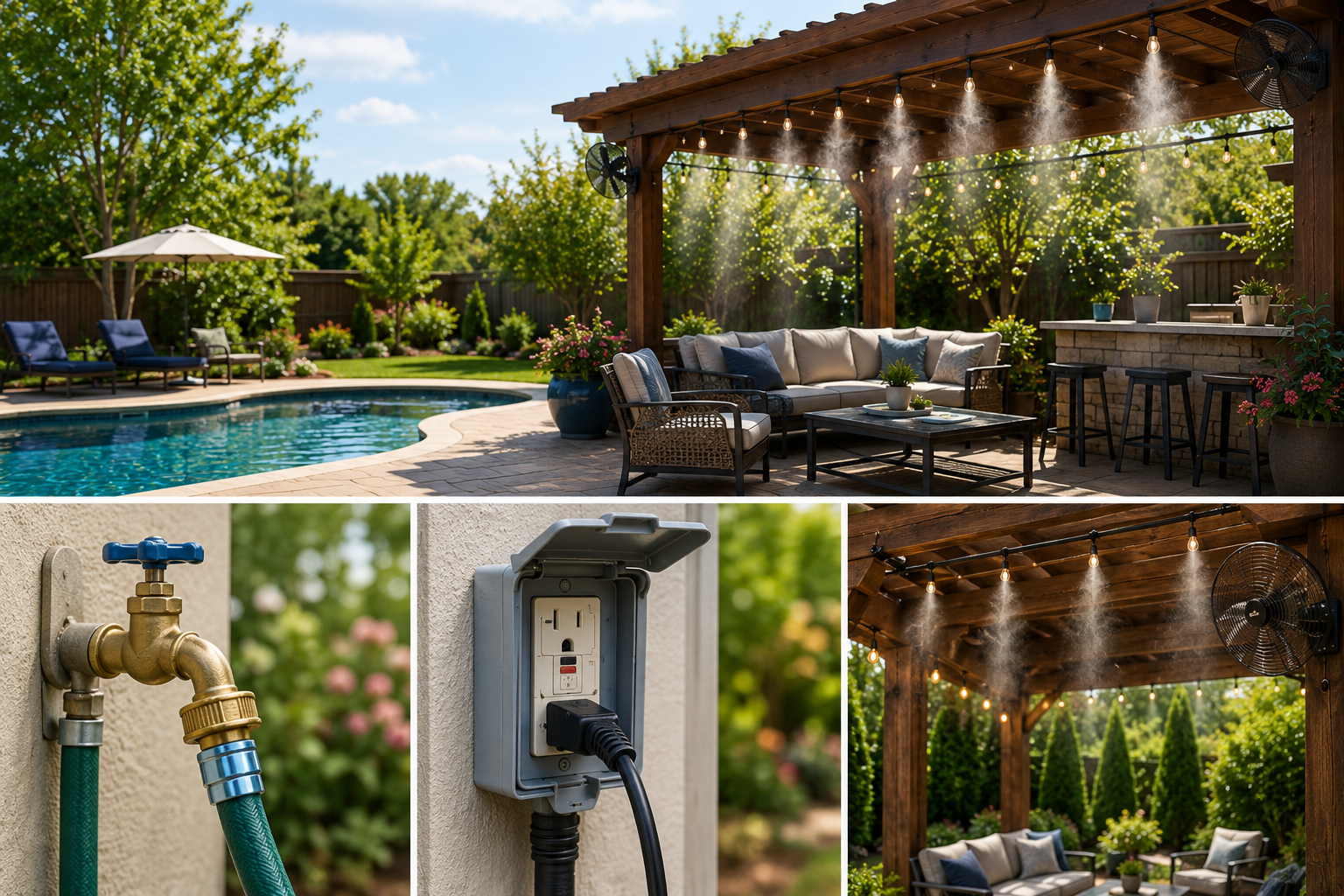
Water access is the first thing to verify because it determines which cooling systems are even viable for your space. A standard garden hose bib running at normal municipal pressure (40–80 PSI) is enough for portable misting fans and low-pressure systems. High-pressure automated misting systems require a dedicated pump that boosts pressure to 800–1,200 PSI — your municipal supply alone cannot deliver that. Know which category your system falls into before planning access.

For Rental / Event Setups — Water
✓ Locate the nearest outdoor hose bib to your event space and measure the distance — most misting fans need a water source within 50 feet
✓ Check that the hose bib is fully functional and not partially closed or leaking at the connection
✓ Have a 50-foot or 100-foot garden hose available — confirm whether your rental includes hose or you need to supply it
✓ If the event is on a property without outdoor water access (parking lot, field), arrange a water tank or barrel ahead of time
✓ For events with multiple misting fans, confirm that one hose bib can supply adequate flow to all units simultaneously — splitting at a manifold reduces pressure
✓ Run the hose and test water pressure at the unit location before event day, not on it
For Permanent Installations — Water
✓ Identify the main water supply entry point to your property and confirm the shut-off valve is accessible and functional
✓ Check your home’s water pressure at an outdoor bib using a simple pressure gauge — target 45–80 PSI for standard systems
✓ If pressure reads below 40 PSI, discuss a booster pump option with your installer before committing to a system
✓ Determine the most efficient routing path from your water source to the planned nozzle locations — unnecessary line length reduces pressure
✓ For high-pressure automated systems, verify there is space for the pump unit in a shaded, sheltered location (garage, shed, or covered utility area)
✓ Identify where the system drain point will be for winterization — lines need to be blown out before freezing temperatures, even in College Station
✓ If your property has a well, confirm with your installer that flow rate and pressure are sufficient before system sizing begins

Checklist 2: Power Access Planning

Power is the second most common planning gap for outdoor cooling systems. A standard misting fan draws 1–3 amps at 120V — a normal outdoor outlet handles this easily. A high-pressure pump system may draw 8–15 amps continuously and requires a dedicated circuit to avoid tripping breakers during operation. Know your system’s draw before assuming any outlet will do.

For Rental / Event Setups — Power
✓ Locate all outdoor GFCI-protected outlets at your venue and note their positions relative to where cooling units will be placed
✓ Count available outlets — assume one unit per outlet unless your rental provider confirms otherwise
✓ Measure the distance from outlet to unit placement area — If more than 25 feet, you need a heavy-duty outdoor extension cord (14-gauge minimum)
✓ Never daisy-chain extension cords for outdoor misting equipment — voltage drop reduces misting performance and creates a safety risk
✓ If your venue has no outdoor power access, arrange a generator in advance — a 2,000-watt generator comfortably runs 2–3 standard misting fans
For Permanent Installations — Power
✓ Confirm that your electrical panel has capacity for an additional 20-amp circuit if the system includes a high-pressure pump
✓ Identify the most direct conduit route from the panel to the pump location — longer runs require heavier gauge wire
✓ All outdoor electrical connections must be weatherproof and GFCI-protected per NEC requirements — confirm your installer handles this
✓ If installing on a covered patio or pergola, identify existing outdoor outlet locations and whether they are on a GFCI circuit
✓ For timer-controlled automated systems, confirm where the controller will be mounted and that a power source is within reach
✓ Ask your installer whether the system requires a dedicated circuit or can share with existing outdoor outlets — know this before the electrician is scheduled

Power Tip: GFCI Outlets Are Non-Negotiable for Outdoor Water Systems

Any outdoor electrical outlet used with a misting fan, pump, or water-connected cooling system must be GFCI-protected. This is both a safety requirement and a code requirement in Texas. If your outdoor outlets are not GFCI-protected, have them upgraded before any cooling system is connected. This is a simple, inexpensive electrical fix that is far cheaper than the alternative.

Checklist 3: Layout and Coverage Planning

Layout planning is where the effectiveness of your outdoor cooling system is actually determined. A well-positioned misting fan covers its zone efficiently. A poorly positioned one blows mist into a wall or cools an area where no one sits. For permanent systems, nozzle placement defines performance for years — it deserves careful thought before anything is drilled or routed.

For Rental / Event Setups — Layout
✓ Walk your entire event space before the rental arrives and identify the zones where guests will spend the most time: seating areas, bar station, food area, entrance
✓ Position misting fans to blow across guest zones, not toward walls, fences, or enclosed corners where mist accumulates
✓ For covered areas, face fans inward from the perimeter — not toward the ceiling where mist dissipates without cooling anyone
✓ Keep fans at least 6 feet from any food display, electronics, sound equipment, or paper signage
✓ In open areas, orient fans perpendicular to the prevailing wind direction — wind behind the fan disperses the mist before it reaches guests
✓ Place units at a height of 5–6 feet where possible — too low and the mist hits legs; too high and it evaporates before reaching people
✓ Leave a clear path for power cords and water hoses that doesn’t cross guest traffic areas — tripping hazards are a liability
For Permanent Installations — Layout
✓ Walk the property with your installer and identify every zone you want cooled: patio, pool deck, garden seating area, outdoor kitchen
✓ Note where the sun hits hardest during peak hours (2–5 PM) — those zones need the most cooling coverage and should be prioritized in nozzle placement
✓ Identify existing structures that can support nozzle lines: pergola beams, fence tops, eave lines, patio covers — these reduce the need for freestanding poles
✓ Plan nozzle spacing based on your system pressure: low-pressure systems space nozzles every 18–24 inches; high-pressure systems every 24–36 inches
✓ Avoid routing nozzle lines directly above outdoor furniture, BBQ grills, or high-use surfaces where drip from nozzle ends accumulates
✓ Plan the line routing to allow access for seasonal maintenance — nozzles need periodic cleaning and lines need winterization each year
✓ Confirm with your installer where the drain/flush point will be at the lowest elevation of the system for end-of-season blowout

Applying the Checklist: Rentals vs Permanent Systems in College Station

For a one-day or weekend rental, the checklist above can be worked through in an hour the day before your event. The goal is simply to confirm that water is accessible, power is available and safe, and you’ve thought through where units will go. Our outdoor cooling rental College Station team reviews these exact points with every customer before delivery — but knowing the answers before you call makes the process faster and ensures the right equipment gets sent.

For a permanent misting system installation in College Station, the layout planning checklist is something we work through during a free on-site assessment before any equipment is ordered. No two properties are the same — lot size, existing structures, water pressure, and how the space is used all factor into the final system design. The assessment takes about 30 minutes and costs nothing.

If you’re unsure whether a rental or permanent install makes more sense for your situation, our outdoor cooling systems guide College Station walks through the decision in detail. Most homeowners who host outdoors more than four or five times per season find that a permanent system pays for itself within two to three years compared to cumulative rental costs.

Quick Pre-Booking Checklist Summary

✓ Water source identified and tested within range of cooling zone
✓ Outdoor GFCI outlet confirmed within 25 feet or generator arranged
✓ Primary guest zones mapped and unit positions planned
✓ Cord and hose routing planned to avoid trip hazards
✓ Food, electronics, and sound equipment noted and kept clear
✓ For installs: panel capacity confirmed and installer walkthrough scheduled

Ready to Install or Rent Outdoor Cooling in College Station?

Call Backyard Comfort & Pest Control at (979) 324-3223 or visit
backyardcomfortandpestcontrol.com to get a free site assessment and quote. We handle water, power, and layout planning for you. Serving College Station, Bryan, and the entire Brazos Valley. Delivery, setup, and takedown included on all rentals.

Share This Story, Choose Your Platform!

Leave A Comment

Categories

Recent Works

Tags

outdoor cooling rental Bryan TX mosquito activity by month Texas yard mosquito spray schedule Bryan TX portable misting fan rental Brazos Valley misting fan for outdoor events Texas outdoor fan rental near me College Station rent a misting fan College Station TX backyard event cooling rental industrial misting fan rental Texas when does mosquito season start College Station mosquito season Bryan TX how long is mosquito season Texas mosquito prevention College Station mosquito control Brazos Valley best time for mosquito treatment College Station monthly mosquito service cost Texas mosquito control quote College Station professional mosquito treatment Brazos Valley mosquito misting system College Station best mosquito repellent for yard Texas outdoor mosquito control near me termite swarmers Texas subterranean termite season Brazos Valley termite signs College Station TX termite inspection Bryan TX winged termites in home termite treatment College Station termite damage signs Texas when do termites swarm in Texas termite control near me College Station standing water mosquitoes Texas get rid of mosquitoes outside is mosquito control worth it College Station affordable mosquito control Bryan TX one-time vs monthly mosquito treatment cost misting system installation College Station patio cooling setup guide misting fan water pressure requirements outdoor cooling power requirements Texas how to plan outdoor cooling system backyard cooling layout guide misting system planning College Station event cooling setup Brazos Valley mosquito control Bryan TX yard mosquito spray College Station